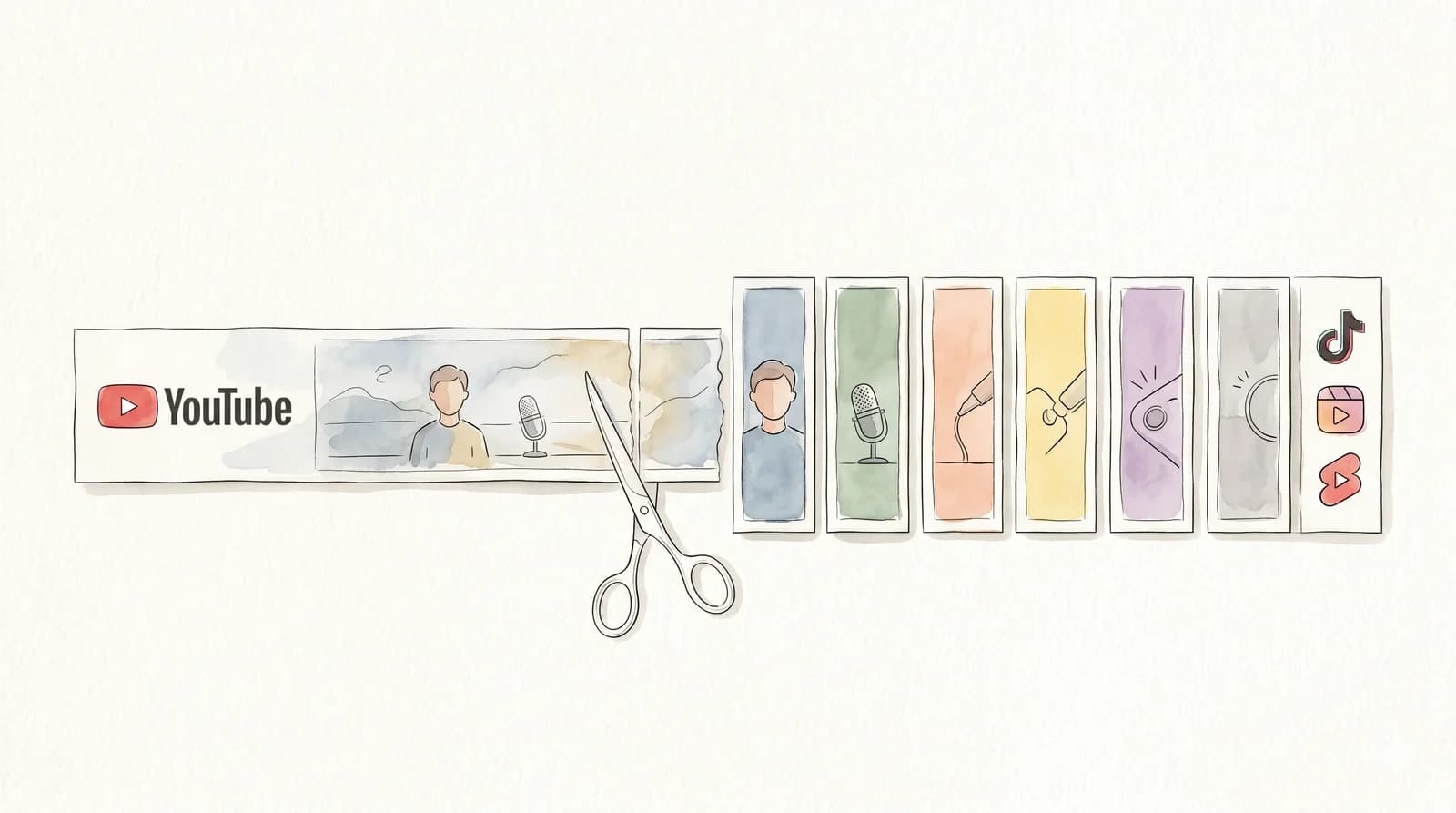

Most creators upload a YouTube video and move on. The top 1% turn that same video into 30+ TikToks, Reels, and Shorts — and schedule them weeks out. Here's the exact workflow.
Why Repurposing YouTube to Short-Form Is a No-Brainer
Long-form YouTube videos are gold mines. A single 20-minute tutorial contains dozens of quotable moments, tips, and micro-stories that perform well as vertical clips. The problem? Manually cutting, cropping, captioning, and uploading each one takes hours.
The math is simple: one 20-minute video → 15–30 clips → weeks of consistent posting across TikTok, Instagram Reels, and YouTube Shorts.
The ROI: creators who repurpose consistently see 3–5× more total reach from the same amount of production work.
Step 1: Identify High-Value Clip Moments
Not every second of your video is clip-worthy. Look for:
- Hook moments — the first 3 seconds that stop the scroll
- Standalone tips — single insights that make sense without context
- Strong opinions — contrarian takes that invite comments
- Before/after reveals — transformation moments that are visually compelling
A 20-minute video typically yields 10–20 strong clip candidates.
Step 2: Extract 3-Second Clips
Short-form platforms reward the first 3 seconds above everything else. Longer clips (15–60s) can work, but the entry point — the hook — determines whether the algorithm pushes your content.
For TikTok specifically, the loop metric matters: videos under 7 seconds that get re-watched count as engagement signals that boost distribution.
Tools like Clip3s let you scrape clips directly from any TikTok or YouTube channel URL, automatically extracting the highest-engagement moments.
Step 3: Stitch Your CTA
Every clip needs a call-to-action stitch at the end. This is a 1–2 second branded outro with:
- Your handle or watermark
- A single action ("Follow for more", "Link in bio", "Comment below")
- Consistent color scheme for brand recognition
The stitch frame is what converts viewers into followers. Without it, you're growing someone else's audience.
Step 4: Bulk Schedule Across Platforms
Scheduling one video at a time across TikTok, Reels, and Shorts is where most creators give up. The solution is bulk scheduling:
- Upload all clips to your scheduler in one batch
- Set your posting cadence (e.g., 2× per day on TikTok, 1× on Reels)
- Let the scheduler distribute them automatically
With 30 clips queued, you're covered for 2–3 weeks across all platforms — from a single YouTube video.
Optimal Posting Frequencies
| Platform | Recommended Frequency | Best Times (EST) |
|---|---|---|
| TikTok | 1–4× per day | 7am, 12pm, 7pm |
| Instagram Reels | 1–2× per day | 9am, 6pm |
| YouTube Shorts | 1× per day | 8am, 3pm |
Step 5: Analyze and Double Down
After 2 weeks, check your analytics for:
- Watch time % — clips above 80% completion are your best performers
- Comments per view — signals strong opinion or emotion
- Profile visits — your CTA stitch is working
Take your top 3 clips and create 5 variations of each — same topic, different hook. This is how systematic creators build momentum without burning out.
The Full Workflow at a Glance
- Upload YouTube video → identify 15–20 clip moments
- Extract 3-second clips (or 15–60s for broader context)
- Stitch CTA frame onto each clip
- Bulk upload to Clip3s → assign to TikTok, Reels, Shorts queues
- Schedule 2–4 weeks out
- Review analytics → iterate on top performers
Total time: 45–90 minutes per YouTube video to fill weeks of content.
Ready to Build Your Clip Pipeline?
Stop posting once and hoping. Turn every YouTube video into a content engine that posts itself for weeks.
Start your free trial on Clip3s — no credit card required.