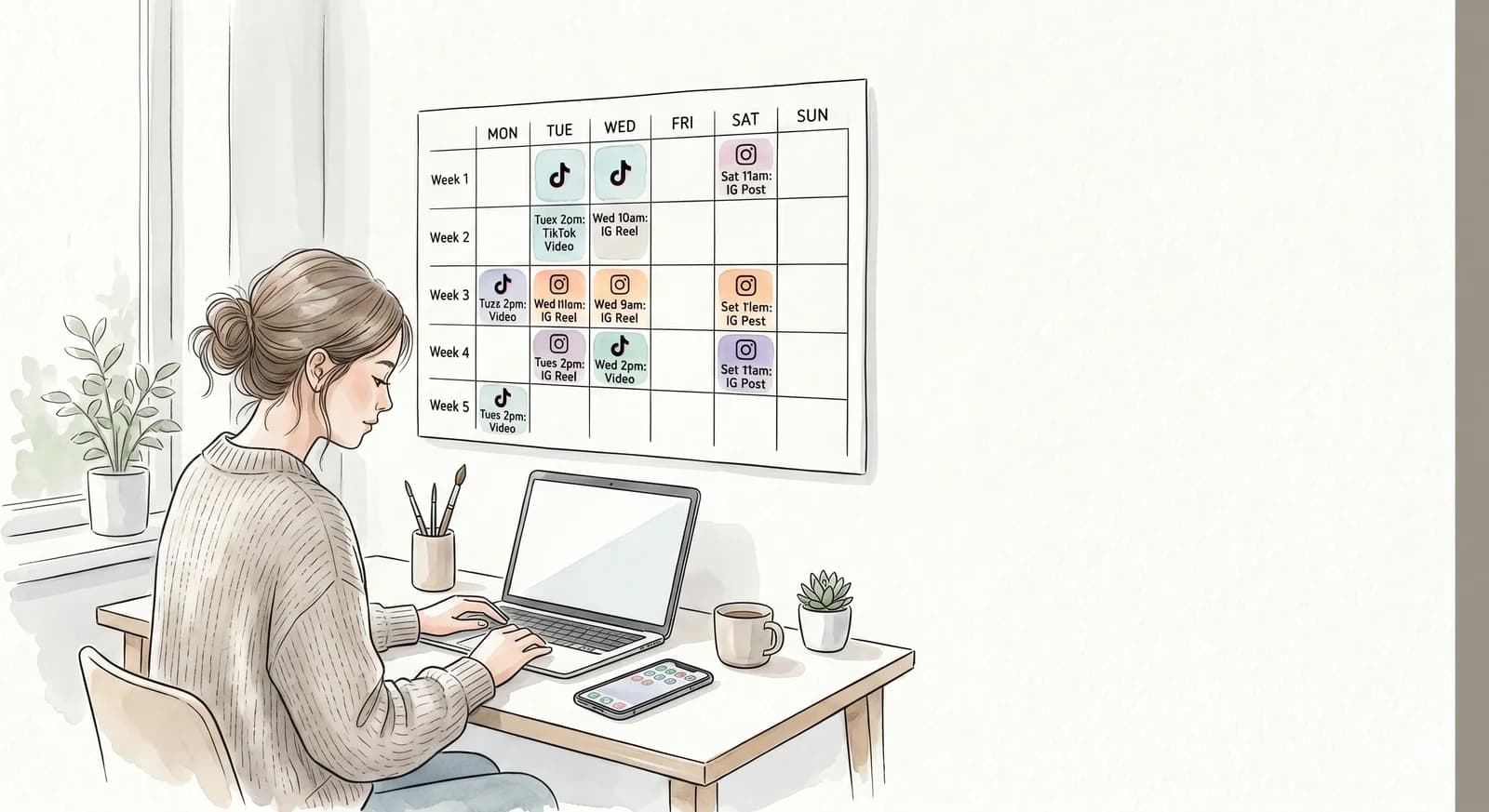

A content repurposing strategy is simple: take one piece of hero content, extract every format variant it can produce, then schedule those variants systematically across platforms. Done right, a single 30-minute video becomes 30+ individual assets — clips, carousels, quotes, threads, blog posts — distributed over weeks without touching the record button again.
Why Most Creators Waste 80% of Their Content
You spent hours researching, scripting, filming, and editing. Then you uploaded once and moved on.
That's the default. It's also why most creators plateau. The algorithm doesn't reward volume alone — it rewards consistency at scale. You can't post daily without a system. A content repurposing strategy is that system.
The creators who compound their reach aren't producing more. They're extracting more from what they already made.
The Content Multiplication Table
One 30-minute YouTube video, podcast episode, or webinar recording can generate all of this:
| Source Asset | Format Variants You Can Extract |
|---|---|
| 30-min YouTube video | 10–20 vertical clips (15–60s), 1 blog post, 1 email newsletter |
| Vertical clips | TikTok posts, Instagram Reels, YouTube Shorts, LinkedIn video |
| Blog post | Pinterest pin, LinkedIn article, Twitter/X thread |
| Strong quote moments | Static carousel slides, pull-quote graphics, Story stickers |
| Data or framework mentions | Infographic, carousel, chart post |
| Contrarian opinion | Twitter/X thread, LinkedIn thought-leadership post |
| Interview or panel segment | Standalone clip per guest answer |
A 30-minute video, extracted systematically, fills 4–6 weeks of daily posts across four platforms — from a single recording session.
The 3-Step Content Repurposing Strategy
Step 1: Identify Hero Content
Not all content is worth repurposing. Prioritize recordings that already proved themselves:
- Videos with above-average watch time — audience held attention, which signals value
- Podcasts or interviews with multiple quotable moments — dense insight = many extractable clips
- Evergreen topics — content that stays relevant for months outperforms trend-chasing
- Your own best-performing posts — if a short clip hit, the long-form version is worth mining
If you're starting from scratch, record with repurposing in mind. A 20–40 minute format gives you more raw material than a 5-minute video. Structure your content around discrete, standalone points — each one is a clip candidate.
One rule: don't repurpose underperforming content. If the original flopped, distributing more of it won't fix it. Repurposing amplifies signal — it doesn't create it.
Step 2: Extract Format Variants
This is where most content repurposing strategies stall. Creators know they should extract clips. They just don't do it systematically.
Work through each format category in order:
Video clips first. These are the highest-leverage asset. Each clip should:
- Open with a hook in the first 2–3 seconds (a bold claim, a surprising fact, or a direct question)
- Deliver one complete idea — no setup required to understand it
- End with a natural close or a clear CTA frame
Target 10–20 clips per long-form video. You won't use all of them immediately, but having the batch means you're never scrambling for content.
Written assets second. Your transcript is a blog post draft. Run it through an editor, not a rewriter. Pull the strongest 3–5 sentences for standalone quote graphics. Extract any numbered list or framework for a carousel.
Static graphics last. Pull-quotes, stats, and checklists convert well as still images on Pinterest, LinkedIn, and Instagram carousels. They take 10 minutes each and extend the lifespan of the same ideas for months.
Step 3: Schedule Systematically
Extraction means nothing without distribution. The goal is to remove daily decision-making from your workflow.
- Batch your clips into a scheduler in one session. Don't drip-upload one at a time. Load the full batch from a single recording.
- Assign each clip to a platform queue — TikTok, Reels, Shorts, LinkedIn — based on format fit (covered in the next section).
- Set your posting cadence and let it run. A 30-clip batch at 2× per day on TikTok covers 15 days. Add Reels and Shorts queues and you're looking at 3–4 weeks from one recording.
Clip3s handles the clip extraction and scheduling piece directly — you upload your clips, assign them to platform queues, and it posts automatically on your schedule. No daily logins required.
Platform-Specific Format Considerations
The same clip doesn't perform equally everywhere. Optimize before you schedule.
TikTok
- Hook weight is extreme. The first 2 seconds determine whether TikTok serves it. Lead with action, not context.
- Loops matter. Clips under 7 seconds that get rewatched send strong engagement signals to the algorithm.
- Captions required. A large share of TikTok is watched without sound. Every clip needs on-screen text.
- Frequency: 1–4× per day is sustainable if you have a full batch queued.
Instagram Reels
- Aesthetic matters more than on TikTok. Reels audiences expect higher production value — good lighting, clean cuts, readable typography.
- Hashtags still work. Use 5–10 niche-relevant tags per post.
- Cross-post carefully. Reels penalizes obvious TikTok watermarks. Export a clean version.
- Frequency: 1–2× per day.
YouTube Shorts
- SEO is the differentiator. Unlike TikTok or Reels, Shorts benefit from optimized titles and descriptions. Write them like search queries.
- Longer clips work. Shorts supports up to 60 seconds, and longer clips with strong retention can outperform 15-second clips.
- Frequency: 1× per day is enough to feed the Shorts feed without cannibalizing your long-form content.
- Native video outperforms links. Upload directly — don't share a TikTok URL.
- The audience is different. What works on TikTok (casual, fast-cut) needs a slower pace and more explicit professional framing on LinkedIn.
- Repurpose your frameworks and opinions as text posts. LinkedIn's algorithm still surfaces long-form text well. A carousel or written post from the same source material can outperform the video clip.
Common Mistakes That Kill the Strategy
Repurposing without editing. A YouTube clip dropped raw onto TikTok rarely works. You need to add captions, tighten the opening 2 seconds, and crop to vertical. Repurposing is not re-uploading.
Going wide before going deep. Starting on 6 platforms at once spreads your capacity too thin to learn anything. Start with 2 platforms, optimize for them, then expand.
Repurposing everything equally. Not every moment from your recording deserves a clip. Be selective. 10 strong clips outperform 30 mediocre ones.
No CTA stitched at the end. Every clip should end with a branded frame — your handle, a follow prompt, a link. Without it, you're growing platform audiences, not your own.
Inconsistent scheduling. A batch of 20 clips posted randomly gives you no data. Consistent posting at set intervals is what lets you compare performance and improve.
Letting the batch run out. Most creators go hard for 3 weeks, then stall when the queue empties. Build the habit of recording → extracting → scheduling as a single monthly workflow, not a one-off sprint.
Building the Habit: Monthly Repurposing Workflow
A content repurposing strategy only works if it's a system, not a project. Here's a repeatable monthly cadence:
- Record 2–4 long-form pieces (YouTube, podcast, webinar)
- Extract clips in one batch session — aim for 40–60 clips total per month
- Write the companion blog posts from transcripts
- Schedule all clips across TikTok, Reels, Shorts, and LinkedIn queues
- Review analytics at the end of the month — identify the top 5 clips and create variants
At steady state, this is 1–2 focused days of repurposing work per month to maintain daily posting across 4 platforms.
Ready to Build a Content Machine?
Stop leaving your best content on a single platform. Every video you've already made is a full month of clips, carousels, and posts waiting to be extracted.
Start repurposing on Clip3s — bulk clip scheduling across TikTok, Reels, and Shorts, without the manual work.